 跳至內容
跳至內容 
介紹
Polyethyleneimine (PEI) is a widely used cationic polymer in industries such as water treatment, paper manufacturing, coatings, adhesives, and specialty chemicals. Although PEI offers excellent performance in many industrial applications, residual PEI in process water or wastewater can become a treatment challenge. In such cases, adsorption using activated carbon is an effective and practical solution.
Among different carbon products, high surface area acid-washed coal-based granular activated carbon (GAC) is especially suitable for PEI removal due to its developed pore structure, low ash content, clean surface, and strong adsorption performance.
Why PEI Needs to Be Removed
PEI is a polymer rich in amine functional groups, which gives it strong reactivity and excellent binding performance. However, when PEI remains in water or liquid process streams, it may cause several problems:
• Increased organic load in wastewater
• Interference with downstream treatment processes
• Membrane fouling risk
• Water quality instability
• Difficulty in reuse or discharge compliance
Because PEI is a polymeric organic compound, its removal often requires an adsorbent with both high surface area and a suitable pore structure.
Why Use Activated Carbon for PEI Removal?
Activated carbon is one of the most commonly used adsorbents for removing organic compounds from water. It is highly effective because of its large internal surface area and developed pore structure. In PEI removal applications, activated carbon offers several important benefits:
- Strong adsorption performance for residual organic compounds
- Easy integration into existing treatment systems
- Suitable for continuous operation in fixed-bed filters
- Effective as a polishing step after primary treatment
- Capable of improving final water quality
For industrial PEI removal, granular activated carbon (GAC) is especially preferred due to its operational convenience and stability in large-scale systems.
Why Choose High Surface Area Acid-Washed Coal-Based Granular Activated Carbon?
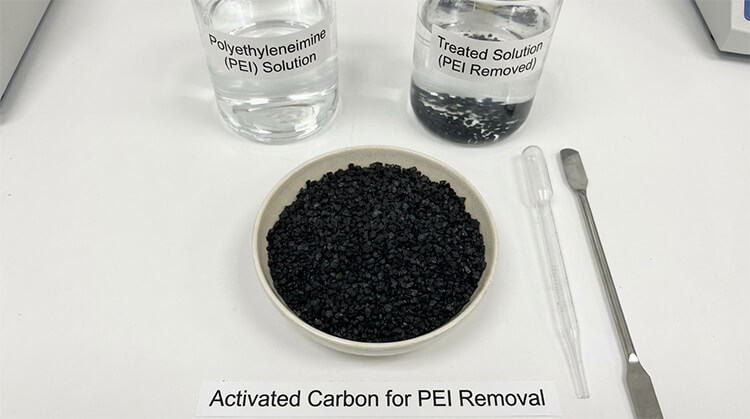
Not all activated carbons perform the same way in polymer removal applications. For PEI adsorption, the activated carbon should have a clean surface, suitable pore structure, high adsorption capacity, and excellent mechanical strength. That is why high surface area acid-washed coal-based granular activated carbon is an ideal option.
High Surface Area
A higher surface area provides more adsorption sites for PEI molecules. This improves the overall adsorption capacity and supports better removal efficiency, especially when PEI concentration needs to be reduced to low levels.
Acid-Washed Purity
Acid washing removes ash, soluble minerals, and inorganic impurities from the activated carbon. This creates a cleaner pore structure and a purer adsorption surface. The benefits include:
- Lower ash content
- More available adsorption sites
- Reduced risk of leachable impurities
- Better water quality after treatment
- More consistent performance
Coal-Based Carbon Structure
Coal-based activated carbon is known for its well-developed pore network and strong adsorption characteristics for organic contaminants. Its pore structure can support the adsorption of PEI and other dissolved organics in demanding industrial applications.
Granular Form for Industrial Systems
Granular activated carbon is ideal for use in adsorption columns, pressure vessels, and fixed-bed filtration units. Compared with powdered activated carbon, GAC is easier to handle, easier to replace, and better suited for continuous water treatment systems.
High Hardness and Durability
Coal-based GAC usually has excellent mechanical strength. This means lower carbon loss during transportation, loading, backwashing, and operation. It also helps maintain bed integrity and long-term treatment performance.
Applications of Activated Carbon for PEI Removal
High surface area acid-washed coal-based granular activated carbon can be used in many PEI-related treatment systems, such as:
- Chemical manufacturing wastewater treatment
- Polymer and resin production process water
- Coating and adhesive wastewater treatment
- Paper and textile process water purification
- Industrial water reuse systems
- Final polishing before discharge
- Treatment of process streams containing residual amine polymers
Its versatility makes it a practical solution for both new treatment systems and upgrades to existing plants.
客戶案例
A specialty chemical plant had polyethyleneimine (PEI) in its process wastewater.
pH: 7–9
PEI: 50–500 ppm (variable)
Target: ≥90% PEI removal to stabilize final water quality and support reuse/discharge.
Recommended Solution
We recommended a fixed-bed adsorption unit using high surface area acid-washed coal-based granular activated carbon (GAC).
Selected carbon (8×30 mesh):
Iodine value: ≥1050 mg/g
Methylene blue: ≥240 mg/g
Total pore volume: ≥0.75 cm³/g
Mesopore volume (2–20 nm): ≥0.35 cm³/g
Hardness: ≥95%
Result (Customer Outcome)
With the GAC polishing step, the customer achieved stable PEI removal ≥90% across the incoming concentration range (50–500 ppm) at pH 7–9, and improved final water quality for downstream operation.
結論
PEI is an important industrial polymer, but residual PEI in water systems can create treatment and compliance challenges. Activated carbon adsorption is an effective solution, and high surface area acid-washed coal-based granular activated carbon is especially well suited for this application.
With its high adsorption capacity, clean surface, low ash content, strong hardness, and suitability for continuous operation, this carbon type provides a dependable solution for removing PEI from industrial water and wastewater streams.