
giriiş
Industrial waste gases containing volatile organic compounds (VOCs) are often generated during production processes such as spraying, printing, furniture manufacturing, packaging, rubber and plastics, electronics, chemicals, and pharmaceuticals. Inadequate collection and treatment can not only produce noticeable odors but also negatively impact the surrounding environment and the company’s emission management.
Among various VOCs treatment technologies, activated carbon adsorption is characterized by its relatively simple equipment structure, fast start-up speed, and suitability for low-concentration organic waste gases. Honeycomb activated carbon, in particular, incorporates numerous regular channels within the activated carbon material, allowing waste gas to pass through and contact the pore surface. Compared to irregularly shaped granular packed beds, a well-designed honeycomb structure typically offers advantages such as orderly airflow channels, lower pressure loss, and suitability for treating larger volumes of waste gas.
What is honeycomb activated carbon?
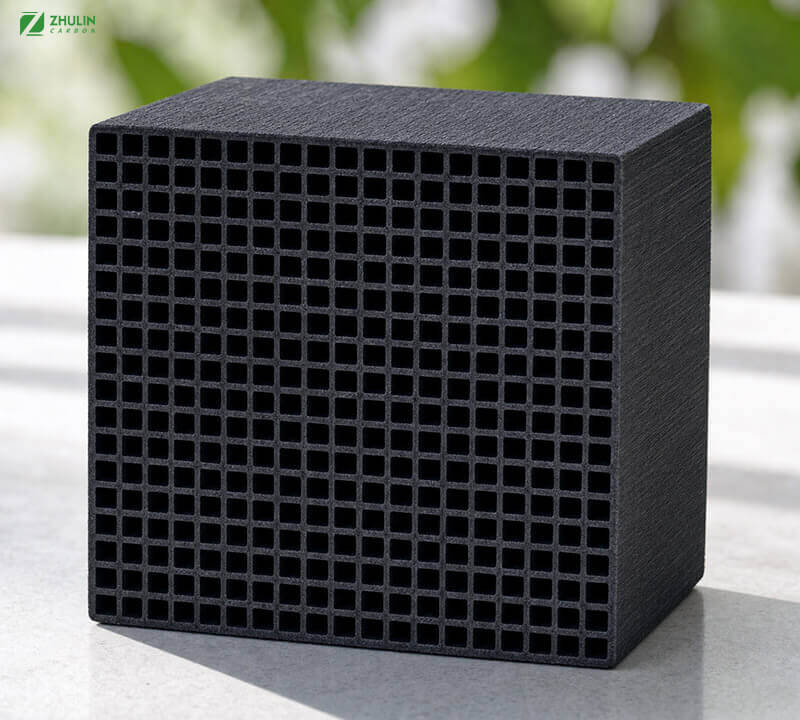
Honeycomb activated carbon is a block adsorbent material made from high-quality coal-based activated carbon powder (or wood-based activated carbon powder) as the main raw material, with the addition of binders, extruded into shape using molds, and then fired at high temperatures. Its appearance is that of a regular cuboid or cube (common sizes are 100×100×100mm and 100×100×50mm), with parallel, interconnected square or circular micropore channels inside, resembling a honeycomb, hence the name.
Different manufacturers have differences in raw material ratios, molding processes, and firing temperatures, therefore the strength, pore size distribution, and adsorption performance of the products also vary. Targeted comparisons are necessary when purchasing.
The honeycomb structure offers three main advantages:
Large specific surface area: The well-developed pore structure provides an adsorption surface area of over 600–1000 m²/g;
Low air resistance: Exhaust gas passes through the straight channels, resulting in a pressure drop far lower than that of granular carbon beds, significantly saving fan energy consumption;
Neat packing: The block design facilitates neat stacking within the adsorption box, ensuring uniform gas distribution.
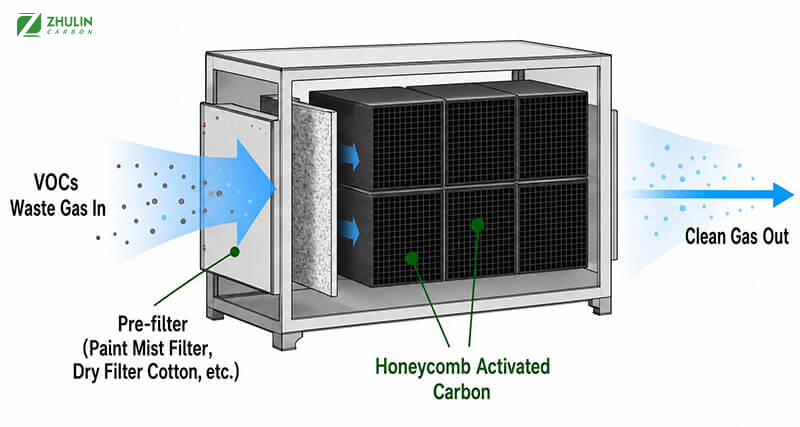
The principle of honeycomb activated carbon for VOCs removal
The core mechanism of VOCs treatment using honeycomb activated carbon is adsorption, not mechanical filtration in the conventional sense.
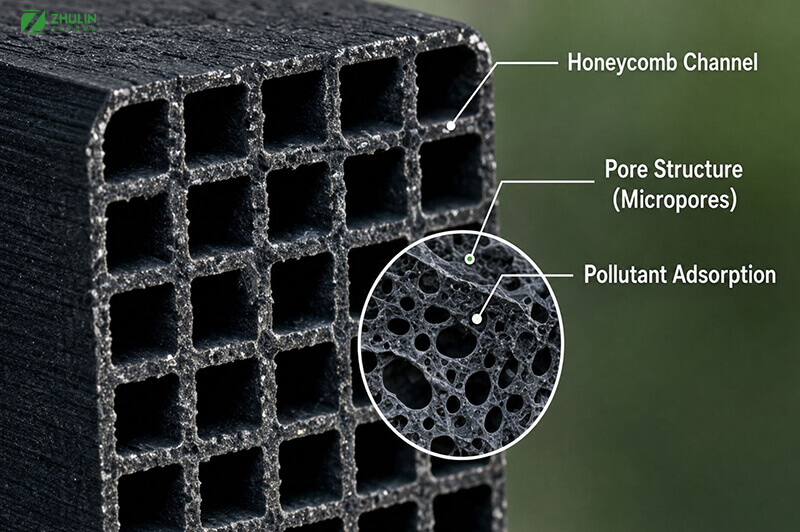
When industrial waste gas passes through the channels of honeycomb activated carbon, organic pollutants are transferred from the gas phase to the surface of the activated carbon, then enter the internal pores and are retained by intermolecular forces or surface chemistry.
The entire process can be roughly divided into the following steps.
1. Waste Gas Enters the Honeycomb Channels
The collected and pre-treated waste gas enters the activated carbon adsorption equipment and passes relatively evenly through the honeycomb activated carbon channels.
A reasonable airflow distribution is crucial. If short-circuiting, dead zones, or excessively high local flow velocities occur within the equipment, some activated carbon may not be fully utilized before the waste gas penetrates to the outlet.
2. Pollutants Migrate from the Airflow to the Carbon Surface
VOC molecules first pass through the gas film on the surface of the honeycomb channels to reach the outer surface of the activated carbon. Gas velocity, pollutant concentration, and flow state all affect this process.
3. Pollutants Enter the Internal Pores
Pollutants diffuse from the outer surface to the interior of the activated carbon. Macropores and mesopores mainly perform mass transfer functions, while micropores provide ample adsorption space.
If the pore size structure of the honeycomb activated carbon does not match the size of the pollutant molecules, even if the product has a high specific surface area, it may not achieve the desired waste gas purification effect.
4. Pollutants are Adsorbed
Most organic vapors are adsorbed by activated carbon primarily through intermolecular interactions such as van der Waals forces. For specially impregnated or modified honeycomb activated carbon, chemical adsorption, catalytic reactions, or surface complexation may also occur.
5. Activated carbon gradually approaches saturation.
As operating time increases, the number of available adsorption sites decreases, and a mass transfer zone gradually moves backward within the activated carbon. When the mass transfer zone reaches the end of the carbon bed, the outlet VOCs concentration begins to rise significantly; this phenomenon is called “breakthrough.”
Therefore, the fact that activated carbon still appears black does not necessarily mean that it still has sufficient adsorption capacity.
Which industries are suitable for honeycomb activated carbon?
Spraying and Coating Industry
During the painting, leveling, paint mixing, and cleaning processes of automotive parts, machinery, metal products, and plastic products, waste gases containing benzene compounds, esters, ketones, and alcohols may be generated.
These waste gases typically need to be pre-treated with dry filter cotton, paint mist filters, or other pre-treatment facilities to remove paint mist and particulate matter before entering the honeycomb activated carbon device.
Furniture Manufacturing Industry
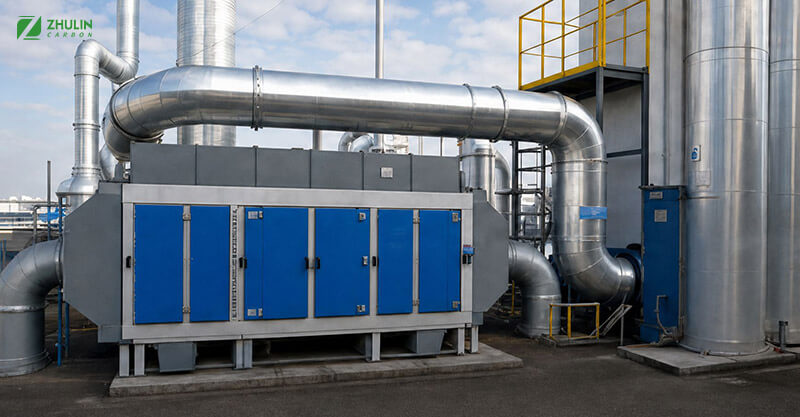
The painting, drying, gluing, and cleaning processes in furniture production may generate VOCs. For waste gases with low concentrations, relatively stable operating conditions, and pre-treated paint mist removal, fixed-bed activated carbon adsorption can be used depending on the actual conditions.
The Ministry of Ecology and Environment’s Feasible Technology Guidelines for the Furniture Manufacturing Industry recommend that the inlet particulate matter concentration of the fixed-bed adsorption device should be below 1 mg/m³, the temperature below 40℃, and the relative humidity below 80%.
Packaging and Printing Industry
Printing, laminating, coating, and cleaning processes may generate ink, diluent, and cleaning solvent volatiles. Honeycomb activated carbon can be used for treating some low-concentration printing waste gases and can also be used in combination with desorption, condensation, or catalytic combustion equipment.
Rubber and Plastics Industry
Complex organic waste gases and odors may be generated during rubber compounding, vulcanization, and plastic injection molding, extrusion, and thermoforming processes.
Due to the complex composition of these waste gases, which may also contain oil mist, particulate matter, or high-boiling-point substances, the use of honeycomb activated carbon cannot be determined solely by the presence of an odor; waste gas composition testing and adsorption suitability assessment should be conducted first.
Electronics and Electrical Manufacturing Industry
Solvent vapors may be generated during circuit board cleaning, coating, drying, and adhesive use. For relatively clean, low-concentration, and stably emitted waste gases, honeycomb activated carbon can serve as an end-of-pipe purification material.
Chemical and Pharmaceutical Industry
Various organic waste gases may be generated during reaction, centrifugation, filtration, drying, filling, and storage processes. Due to the significant differences in the composition, concentration, and safety risks of waste gases, chemical and pharmaceutical projects typically require a combination of processes such as condensation, absorption, adsorption, and combustion, rather than simply using a single-stage honeycomb activated carbon adsorption box.
Çözüm
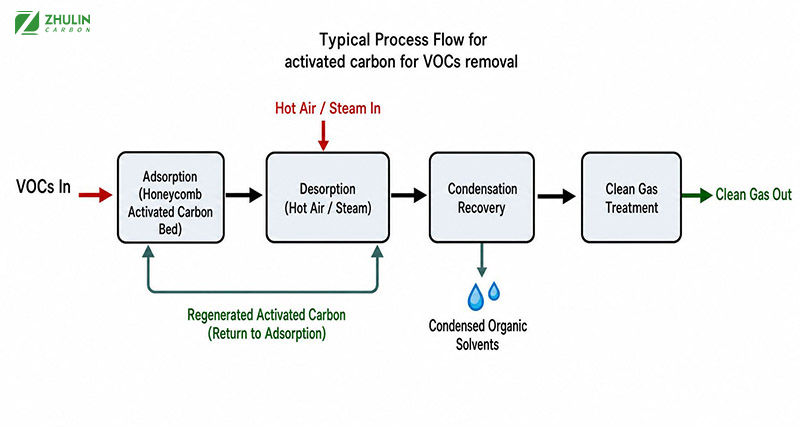
Honeycomb activated carbon is a common industrial waste gas adsorption material, characterized by its regular channels, relatively low pressure loss, convenient modular installation, and suitability for designs with large airflow areas. It can be used to treat some low-concentration VOCs waste gases generated in industries such as spraying, printing, furniture, packaging, electronics, and rubber and plastics. It can also be used in combination with desorption, catalytic combustion, or condensation recovery technologies.
We offer a variety of coal-based/water-resistant honeycomb activated carbons, supporting customized pore sizes and dimensions. We can also assist you free of charge in calculating filling volume and designing adsorption solutions. Welcome to contact us for product quotations and sample testing!
RFQ:
Q1: How long can honeycomb activated carbon be used?
A: It depends on the concentration of the waste gas, the air volume, and whether desorption and regeneration are used. For single use, it generally needs to be replaced every 3-6 months; with a matching desorption and regeneration system, it can be reused for 1-2 years or even longer.
Q2: Can honeycomb activated carbon be washed and regenerated?
A: No. Adsorbed organic matter cannot be removed by washing with water, and ordinary activated carbon will soften and crumble when exposed to water. Regeneration requires hot air/steam desorption, or it can be treated by a professional thermal regeneration unit.
Q3: Can honeycomb activated carbon be used directly to adsorb very high concentrations of waste gas (e.g., several thousand mg/m³)?
A: It is not recommended. Adsorption of high-concentration waste gas releases a lot of heat, posing a risk of combustion and explosion. Condensation recovery, RTO incineration, or a combination of “adsorption concentration + catalytic combustion” processes should be used.
Q4: Approximately how much honeycomb activated carbon can be placed in one adsorption box?
A: Based on the estimated air volume, approximately 0.1–0.2 m³ of honeycomb activated carbon is needed for every 1000 m³/h of air volume. The specific amount needs to be designed in conjunction with the exhaust gas concentration. You can contact us for a free calculation.