

giriiş
Steam condensate is one of the most valuable resources in any power plant, refinery, petrochemical complex, or large industrial boiler system. Every ton of condensate returned to the boiler saves energy, water treatment chemicals, and raw water costs. But condensate is never perfectly clean — as steam travels through turbines, heat exchangers, and miles of piping, it picks up trace contaminants: dissolved organics (TOC), corrosion products (iron oxide), oil and grease leaks, amine residues, and occasionally silica. If these contaminants are not removed before the condensate re-enters the boiler, they accumulate, causing scaling, corrosion, foaming, and ultimately costly equipment failure.
At Zhulin Carbon, we supply high-purity coconut shell activated carbon specifically engineered for condensate polishing applications. In this guide, we explain why condensate purification matters, what contaminants threaten your system, and why coconut shell carbon is the preferred choice for protecting high-pressure boilers and turbines.
What Is Condensate and Why Does It Need Purification?
Condensate is the liquid formed when steam transfers its heat and condenses back to water in surface condensers, heat exchangers, or process heating coils. In a well-designed system, 80–95% of the steam is recovered as condensate — representing enormous energy and water savings. However, even “clean” condensate carries contaminants from multiple sources:
- Process leaks from heat exchangers introduce organics (hydrocarbons, amines, glycols) into the condensate. Even at ppb levels, TOC can decompose in the boiler to form organic acids that lower pH and cause corrosion.
- Iron and copper oxides from pipe walls and heat exchanger tubes enter the condensate as suspended and colloidal particles. These deposit on boiler tubes, causing hot spots and eventual tube failure.
- Lubrication oil from turbine bearings, pump seals, and valve packing can leak into condensate. Oil coats boiler heat-transfer surfaces, drastically reducing efficiency and causing dangerous foaming and carryover.
- Dissolved oxygen and carbon dioxide in condensate cause pitting corrosion in condensate return lines (often called “condensate line thinning”).
- In high-pressure boilers (>60 bar), silica volatility increases; silica returning in condensate can deposit on turbine blades, reducing efficiency and causing blade erosion.
High-pressure boiler feedwater specifications are extremely strict — typically <0.2 ppm TOC, <0.01 ppm oil/grease, and total dissolved solids <0.5 ppm. Condensate polishing with activated carbon is the most effective technology to meet these specifications.
How Activated Carbon Purifies Condensate
Activated carbon removes organic contaminants from condensate primarily through physical adsorption. The carbon’s enormous micropore network traps dissolved organic molecules, oils, and amine decomposition products as the condensate flows through the carbon bed.
- Dissolved organics — amines (morpholine, cyclohexylamine), organic acids, glycol decomposition products — are adsorbed in the micropores. High-purity coconut shell carbon achieves >95% TOC removal, even at inlet concentrations as low as 50 ppb.
- Hydrocarbon-based oils are strongly adsorbed on the hydrophobic carbon surface. Coconut shell carbon can remove trace oil from 5–10 ppm down to <0.01 ppm (non-detectable by standard methods).
- Complex organic molecules formed by amine decomposition or process contamination are captured by a combination of physical entrapment in mesopores and surface adsorption in micropores.
- In systems where amine filming corrosion inhibitors must be removed before certain processes, activated carbon effectively strips neutralizing and filming amines from the condensate stream.
- The packed carbon bed also acts as a depth filter, capturing corrosion product particles (iron oxide, copper oxide) that pass through upstream filters.
In a typical condensate polishing system, the activated carbon filter is positioned upstream of the mixed-bed ion exchange demineralizer. The carbon removes organics that would otherwise foul and poison the ion exchange resin, extending resin life by 3–5 times.
Why Coconut Shell Carbon Is the Best Choice for Condensate Polishing
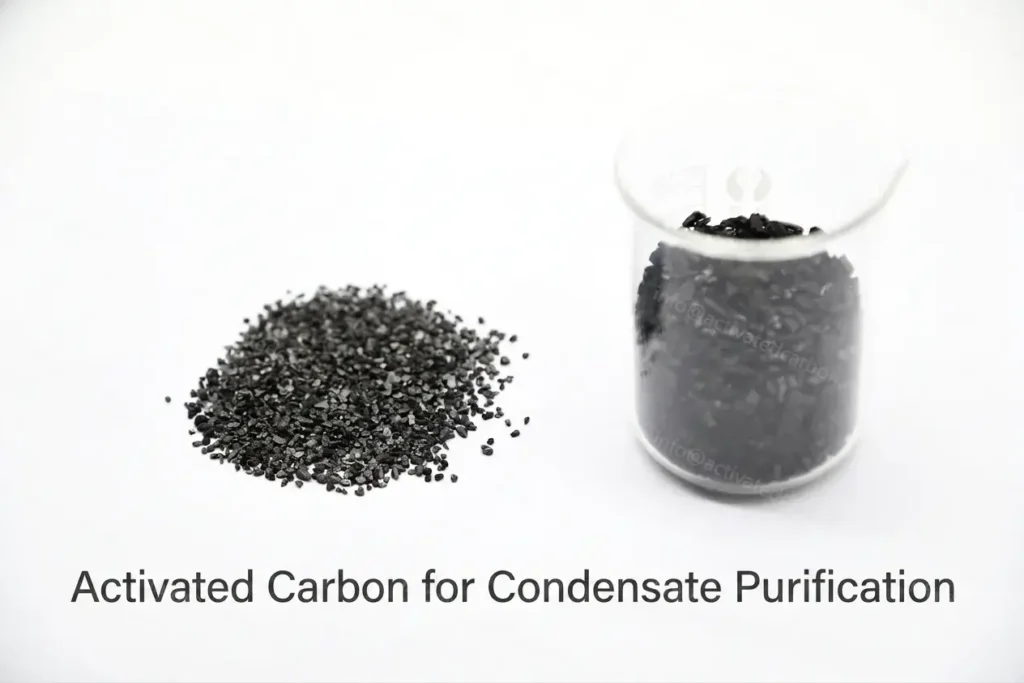
Condensate polishing demands the highest-purity activated carbon available. Even trace impurities leaching from the carbon itself could contaminate the ultra-pure condensate stream. Coconut shell activated carbon is the industry standard for this application for several critical reasons:
- With ash content ≤5% (vs 10–15% for coal-based carbon), coconut shell carbon releases minimal dissolved solids, silica, iron, or other ions into the condensate. This is essential for meeting <0.5 ppm TDS specifications.
- Coconut shell carbon’s surface area of 1,000–1,500 m²/g (overwhelmingly micropores) maximizes adsorption capacity for the small dissolved organic molecules that dominate condensate contamination.
- Unlike coal-based carbon, coconut shell carbon contains negligible silica, preventing silica contamination in high-pressure boiler systems where silica limits are <20 ppb.
- Coconut shell carbon’s mechanical strength prevents fines generation and carbon particle migration that could damage downstream ion exchange resin or boiler components.
- The naturally clean surface requires minimal pre-washing before installation, reducing commissioning time and rinse water consumption.
- Coconut shell carbon can be certified to NSF/ANSI 61 and food-grade standards, making it acceptable for condensate used in food, pharmaceutical, and cosmetics steam systems.
Technical Parameters of Our Coconut Shell Carbon for Condensate Purification
| Parametre | Birim | Şartname | Why It Matters for Condensate Polishing |
| Hammadde | — | Premium coconut shell | Highest purity, lowest leachables |
| Üretim süreci | — | Steam activation (physical activation) | No chemical residues in product |
| Particle Size (mesh) | örgü | 8×30 (0.60–2.36 mm) / 12×40 (0.42–1.70 mm) | Select by flow rate & bed design |
| İyot Sayısı | mg/g | ≥ 1,000 – 1,200 | High micropore development for trace organics |
| Metilen Mavisi Adsorpsiyonu | mg/g | ≥ 180 – 225 | Mesopore capacity for larger organics |
| Specific Surface Area (BET) | m²/g | ≥ 1,100 – 1,500 | Maximum adsorption sites for TOC |
| Total Pore Volume | cm³/g | ≥ 0.50 | Adequate space for molecular diffusion |
| Micropore Volume (<2 nm) | cm³/g | ≥ 0.40 | Dominant micropore structure; ideal for condensate |
| Apparent / Bulk Density | g/cm³ | 0.48 – 0.54 | Optimized mass-per-volume for bed design |
| Hardness / Abrasion Number | % | ≥ 97 | Prevents fines that damage IX resin & boiler |
| Kül İçeriği | % | ≤ 5 | Critical: minimal dissolved solids leaching |
| Water-Soluble Ash | % | ≤ 0.3 | Prevents ionic contamination of condensate |
| Silica (SiO₂) Content | % | ≤ 0.05 | Prevents silica contamination in HP boilers |
| Iron (Fe) Content | % | ≤ 0.02 | Prevents iron leaching into condensate |
| Moisture (as packed) | % | ≤ 5 | Maximum active carbon content |
| pH (aqueous extract) | — | 6 – 8 | Neutral; no pH shift in condensate |
| CTC Adsorption | % (wt) | ≥ 55 – 60 | Confirms well-developed pore structure |
| TOC Removal Efficiency | % | > 95 (typical) | Reduces TOC from ppb levels to near-zero |
| Acid-Washed Option | — | Available (HCl or H₂SO₄ washed) | Further reduces ash leachables for ultra-pure systems |
How to Design a Condensate Polishing System with Activated Carbon
A condensate polishing system using activated carbon is typically configured as a pressure-vessel fixed-bed filter installed between the condensate receiver and the deaerator or ion exchange demineralizer. Here are the key design considerations:
1. Analyze the condensate: Test for TOC, oil & grease, total dissolved solids, pH, iron, copper, and silica. Identify the source of contamination (process leaks, corrosion, amine treatment). This determines whether activated carbon alone is sufficient or if additional pre-treatment is needed.
2. Determine flow rate and EBCT: Condensate polishing typically operates at high flow rates (30–60 bed volumes/hour). An EBCT (Empty Bed Contact Time) of 5–15 minutes is recommended. Higher flow rates or shorter contact times reduce adsorption efficiency; longer contact times improve removal but require larger vessels.
3. Select the right mesh size: 8×30 mesh is standard for large-diameter condensate vessels (lower pressure drop at high flow rates). 12×40 mesh offers slightly higher adsorption kinetics for smaller systems or where space is limited.
4. Bed depth and vessel design: Minimum bed depth: 1.0–1.5 m. Use stainless steel (304/316) or rubber-lined steel vessels. Include a backwash expansion space of 50% above the bed. Install sample ports at the inlet, mid-bed, and outlet for TOC monitoring.
5. Monitor breakthrough: Monitor TOC, oil concentration, and pressure differential across the bed. When outlet TOC exceeds the target (typically <20 ppb for high-pressure boilers), or when pressure drop indicates fouling, backwash the bed and/or replace the carbon. Typical carbon service life: 6–18 months depending on contamination load.
6. Carbon change-out: Spent carbon from condensate polishing is typically non-hazardous and can be disposed of or thermally reactivated. Zhulin Carbon offers spent carbon take-back and supply of fresh carbon in a single coordinated service to minimize system downtime.
Where Is This Technology Applied?
- Power plants (fossil, nuclear, combined-cycle) — turbine condensate polishing
- Refineries and petrochemical plants — process condensate and steam return lines
- Chemical and fertilizer plants — steam condensate from process heating
- Pulp and paper mills — evaporator condensate purification
- Food and beverage industry — culinary steam condensate (food-grade requirement)
- Pharmaceutical manufacturing — pure steam condensate for WFI systems
- District heating systems — condensate return from heating networks
- Industrial boiler houses — condensate polishing for medium and high-pressure boilers
The Economic Case for Condensate Polishing
Investing in activated carbon condensate polishing delivers measurable returns:
- Each ton of purified condensate returned to the boiler saves ~290 MJ of heat energy (vs heating cold makeup water from 20 °C to boiler feed temperature). At scale, this adds up to millions of dollars annually.
- Returning clean condensate reduces the demand for boiler makeup water treatment chemicals (oxygen scavengers, scale inhibitors, pH adjusters) by 50–80%.
- Removing organics, oil, and iron oxide prevents boiler tube fouling, turbine blade deposits, and ion exchange resin fouling — extending equipment life and reducing unplanned outages.
- By removing TOC upstream of mixed-bed demineralizers, activated carbon extends ion exchange resin life from 2–3 years to 5–7 years.
- Meets ASME, EPRI, and IAPWS guidelines for high-purity boiler feedwater.
Why Choose Zhulin Carbon for Condensate Polishing?
Zhulin Carbon understands that condensate polishing is a critical-path application where carbon purity and consistency are non-negotiable. Here is what sets us apart:
- Our coconut shell carbon is steam-activated (no chemical activation residues) with ash ≤5%, water-soluble ash ≤0.3%, and silica ≤0.05% — minimizing any ionic contamination of your condensate.
- For ultra-pure and nuclear-grade applications, we offer acid-washed (HCl/H₂SO₄) coconut shell carbon with even lower leachable content.
- Every batch tested for iodine number, BET, hardness, ash, water-soluble ash, silica, and iron content per ASTM/GB standards.
- Pre-washed carbon available to reduce commissioning rinse time and minimize initial TOC contribution to the system.
- Our water treatment engineers assist with bed sizing, EBCT optimization, vessel specifications, and TOC breakthrough modeling.
- Coordinated spent carbon removal and fresh carbon supply to minimize system downtime during change-out.
- NSF/ANSI 61 certification available for drinking water and food-grade applications; ISO 9001 quality management system.
Çözüm
Condensate purification is essential for protecting boilers, turbines, and downstream equipment in power plants, refineries, and industrial steam systems. Coconut shell activated carbon — with its ultra-low ash, negligible silica, exceptional hardness, and dominant micropore structure — is the gold standard for removing trace organics, oils, and amine residues from condensate streams. With Zhulin Carbon’s high-purity coconut shell carbon grades and technical expertise, operators can achieve TOC removal efficiencies above 95%, extend ion exchange resin life, and realize significant energy and chemical savings.
Ready to optimize your condensate polishing system? Contact our technical team at info@activatedcarbon.net or call +86-19949132731 for free samples, TOC adsorption data, and expert system design support.