 Skip to content
Introduction
Les PFAS (substances per- et polyfluoroalkyles) sont devenues l'un des contaminants les plus problématiques dans le traitement de l'eau à l'échelle mondiale. Connus sous le nom de “produits chimiques à vie”, les PFAS résistent à la dégradation naturelle et sont désormais présents dans les eaux souterraines, l'eau potable, les eaux usées industrielles, les lixiviats de décharge et les eaux de surface du monde entier. Le charbon actif s'est imposé comme l'une des technologies les plus fiables et les plus largement utilisées pour l'élimination des PFAS.
Ce blog explique comment le charbon actif élimine les PFAS, quels sont les types de charbon les plus efficaces et comment sélectionner le charbon adapté à votre application.
Qu'est-ce qu'une AFP ?
Les PFAS sont des produits chimiques synthétiques utilisés dans :
- mousses anti-incendie (AFFF)
- revêtements antiadhésifs
- textiles et agents imperméabilisants
- le placage métallique et l'électronique
- agents de surface industriels
Pourquoi les PFA sont-ils difficiles à enlever ?
Leur liaison carbone-fluor (C-F) est l'une des plus fortes de la chimie organique, ce qui en fait des PFAS :
- très persistant
- mobile dans l'eau
- résistant à la biodégradation
- difficile à traiter par les méthodes conventionnelles
Les PFAS les plus courants sont le PFOA, le PFOS, le PFHxS, le PFBS et bien d'autres encore. En raison des préoccupations croissantes en matière de santé, de nombreux pays exigent désormais des niveaux très bas de PFAS dans l'eau potable, souvent inférieurs à 4 ng/L (parties par trillion).
Comment le charbon actif élimine-t-il les PFAS ?
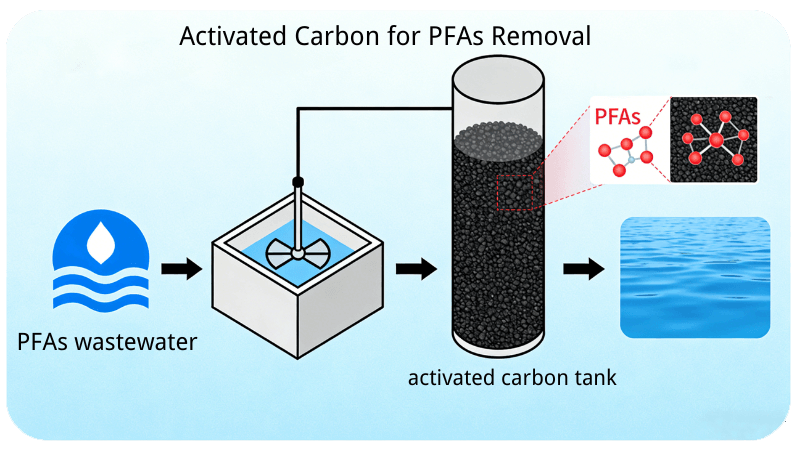
Le charbon actif élimine les PFAS principalement par adsorption, en attirant les molécules de PFAS sur sa surface poreuse.
Facteurs clés qui influencent l'adsorption :
- Interaction hydrophobe : Les PFAS ont des queues hydrophobes qui se lient bien à la surface du carbone.
- Distribution de la taille des pores : Les micropores et les mésopores sont essentiels pour les PFAS à longue chaîne.
- Type de carbone : Les carbones à base de coquille de noix de coco et de charbon présentent la meilleure affinité pour les PFAS.
- Temps de contact (EBCT) : Des temps plus longs améliorent la capacité d'adsorption des PFAS.
Charbon actif granulaire (CAG) à base de charbon
Le charbon actif en grains (CAG) à base de charbon est largement utilisé pour éliminer les PFAS (tels que le PFOA et le PFOS) de l'eau en raison de l'abondance de son volume de micropores, de sa résistance structurelle stable et de sa bonne hydrophobie. Sa forme granulaire convient à un fonctionnement à long terme dans des systèmes de filtration à lit fixe, offrant une capacité d'adsorption soutenue et un long temps de pénétration. Pour les contaminations par les PFAS à faible concentration ou persistantes, le CAG à base de charbon est une option économique, stable et facile à entretenir.
Applications du CAG
- Élimination des PFAS dans le traitement de l'eau potable
- Projets d'assainissement des eaux souterraines
- Filtres à charbon actif à lit fixe dans les stations d'épuration municipales
- Purification en profondeur de l'eau de surface et de l'eau de puits
- Polissage post-traitement des eaux usées industrielles
Charbon actif en poudre à base de charbon (PAC)
Le charbon actif en poudre (PAC) à base de charbon possède une surface spécifique élevée et une cinétique d'adsorption rapide, ce qui le rend adapté aux applications nécessitant une réduction rapide des concentrations de PFAS. Le charbon actif en poudre est généralement ajouté aux masses d'eau via un système de dosage et éliminé par coagulation, sédimentation ou filtration, ce qui le rend adapté aux scénarios de pollution par les PFAS à forte concentration, soudains ou complexes. Sa grande flexibilité en fait un matériau couramment utilisé dans le traitement des eaux usées industrielles et des situations d'urgence.
Applications PAC
- Prétraitement des eaux usées à forte concentration en PFAS dans l'industrie
- Traitement rapide de l'eau contaminée par l'AFFF (Aerosol-Fluorescent Foam) pour la lutte contre les incendies
- Élimination à court terme ou temporaire des PFAS dans les processus de coagulation/sédimentation
- Intervention d'urgence et amélioration à court terme de la qualité de l'eau
- Mesures auxiliaires pour l'élimination des PFAS aux points de rejet industriels
Conclusion
Le charbon actif reste l'une des technologies les plus efficaces, les plus économiques et les plus largement utilisées pour éliminer les PFAS de l'eau. Avec le bon type de charbon et la bonne conception du système, les PFAS peuvent être réduits de manière significative pour répondre aux réglementations strictes en matière de qualité de l'eau.
Si vous avez besoin d'aide pour sélectionner le meilleur charbon actif pour votre projet d'élimination des PFAS, n'hésitez pas à nous contacter - nous pouvons vous recommander la qualité idéale de CAG ou de PAC en fonction de la qualité de votre eau et de vos objectifs de traitement.