 跳到内容
跳到内容 
Introduction
Hydrocarbons and volatile organic compounds (VOCs) are frequent impurities found in natural gas during extraction, processing, and transportation. These contaminants can lead to condensate formation, equipment fouling, corrosion, and unstable system performance. One of the most effective materials for solving this problem is pelletized (extruded) activated carbon, known for its high mechanical strength and excellent adsorption performance.
Why Hydrocarbons Must Be Removed
Typical hydrocarbons in natural gas include:
• methane,
• ethane
• propane
• butane
• nitrogen
• aromatic compounds
• light condensate fractions
If not removed, these impurities can form liquid condensates in pipelines, reduce gas purity, increase wear on compressors and dryers, impair catalyst efficiency in downstream processes, and raise both operational and maintenance costs. Effective purification is essential to ensure stable system performance and consistent product quality.
Which Type of Activated Carbon Is the Best Choice
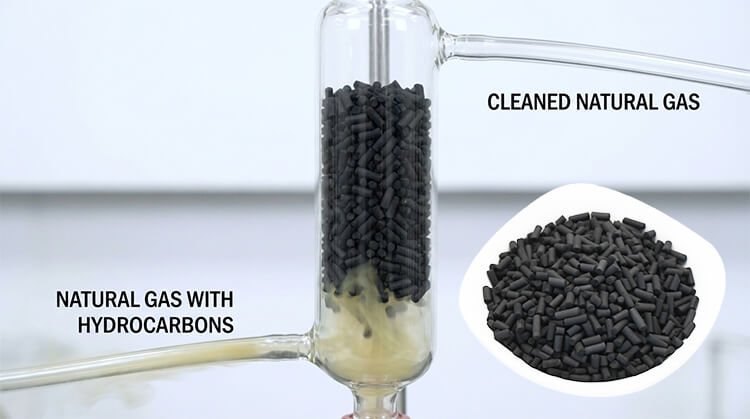
For hydrocarbon removal, pelletized activated carbon (also known as extruded activated carbon) is preferred because of its unique structural advantages:
• High mechanical strength
Prevents dusting and ensures long service life in high‑flow gas systems.
• Large specific surface area and pore volume
Ideal for capturing small and mid‑sized hydrocarbon molecules.
• Low pressure drop
Uniform cylindrical pellets allow smooth gas flow and high adsorption efficiency.
• Thermal and chemical stability
Suitable for demanding natural gas purification conditions.
These characteristics make pelletized carbon the industry standard for hydrocarbon adsorption units.
Pellet Activated Carbon Parameters
| Parameter | Specification |
|---|---|
| Particle Size (Pellet Diameter) | 2 mm, 3 mm, 4 mm |
| Iodine Number | 900–1100 mg/g |
| BET Surface Area | 900–1200 m²/g |
| CTC Activity | 50%–80% |
| Hardness | ≥ 95% |
| Moisture | ≤ 5% |
| Ash Content | 5%–10% (depending on raw material) |
| Bulk Density | 420–600 kg/m³ |
| Pore Structure | Micropore‑rich (ideal for light hydrocarbons) |
| Strength | Very high mechanical strength, low dust formation |
| Packaging | 25 kg bags, 500 kg big bags, or customized |
Typical Applications in Gas Treatment
Pelletized activated carbon is commonly used for:
- Hydrocarbon and VOC removal from natural gas streams
- Pre‑treatment before dehydration and compression
- Gas purification in LNG and LPG facilities
- Biogas upgrading
- Protection of catalysts in chemical production
- Removal of condensable organics in pipelines
Its high durability makes it ideal for continuous, high‑pressure operations.
Customer Case
In real industrial applications, different sectors and processing goals require activated carbon with highly specific adsorption performance and structural characteristics.
One of our customers from the petroleum gas industry needed a solution to remove hydrocarbons (VOCs) from LPG vapor streams. The system required stable long‑term adsorption capacity to treat 1000 m³/h of gas, with three LPG storage tanks, each with a capacity of 1250 kg. VOC concentrations in the gas phase were measured at 2800 ppm, 1200 ppm, and 600 ppm, respectively. The customer wanted to know what grade of activated carbon should be used and how long the carbon could operate before replacement.
Zhulin Carbon calculated the actual VOC load based on the customer’s data:
• Average VOC concentration: 1533.33 ppm
• VOC mass loading per hour: 1.095 kg/h
• VOC mass loading per day: 26.27 kg/day
This represents a continuous and substantial level of hydrocarbons in the gas stream, making high‑performance, mechanically strong activated carbon essential.
Required Activated Carbon Specifications
| Item | Iodine Number | CTC | Diameter |
| Coal activated carbon | ≥ 950 mg/g | ≥ 60% | 3–4 mm |
| Note: Recommended Replacement Cycle Every 3 months | |||
The recommended activated carbon met all required performance targets during evaluation. It successfully adsorbed volatile hydrocarbons from the LPG gas phase, kept VOC levels stable, and helped the customer maintain safe, efficient operation of their storage and processing system.
Conclusion
Pelletized activated carbon is the most reliable and cost‑effective solution for removing hydrocarbons from natural gas. With high mechanical strength, excellent adsorption capacity, and low pressure drop, it ensures consistent gas purification across upstream, midstream, and downstream applications.