
Introduction
Dissolved Air Flotation (DAF) is one of the most widely used primary treatment technologies for oily wastewater across refineries, petrochemical plants, steel mills, food processing facilities, and produced-water sites. By releasing microscopic air bubbles into the water, DAF efficiently lifts free and emulsified oil droplets, suspended solids, and FOG (fats, oils, and grease) to the surface for skimming.
However, DAF effluent—while significantly cleaner than the raw influent—still carries a residual load of dissolved organics, dissolved oil fractions, surfactants, and fine colloidal matter that cannot be removed by flotation alone. Typical DAF effluent may still contain 5–50 mg/L of oil & grease and 50–500 mg/L of COD, often exceeding regulatory discharge limits or reuse-quality requirements.
This is where activated carbon adsorption plays a critical role as a polishing step. This article explores how Zhulin Carbon’s coal-based granular activated carbon (GAC)—specifically engineered at 12×40 mesh with an iodine number of 900 mg/g—delivers reliable, cost-effective treatment of DAF effluent oily water to meet the most stringent discharge and reuse standards.
Understanding DAF Effluent: What Remains After Flotation
A well-operated DAF system removes 80–95% of free oil (droplets > 50 µm) and a significant portion of emulsified oil. But what passes through into the effluent stream? The residual contaminants fall into several categories:
- Dissolved & Soluble Oil: free oil droplets below 20 µm and micro-emulsions that escape the flotation zone
- Dissolved Organics: BTEX (benzene, toluene, ethylbenzene, xylene), phenols, cresols, and other aromatic hydrocarbons with high solubility
- Surfactants & Emulsifiers: residual polymers, emulsifiers, and detergents that stabilize micro-droplets
- Colloidal Solids: non-settleable sub-micron particles that carry adsorbed oil films
- COD & TOC: residual organic load measured as COD/TOC, often 50–500 mg/L depending on the source industry
These dissolved and colloidal species are invisible to the naked eye and cannot be removed by gravity separation, flotation, or even conventional filtration. They require adsorption—the molecular-level capture offered by activated carbon’s vast internal pore network.
How Activated Carbon Treats DAF Effluent Oily Water
Activated carbon removes residual contaminants from DAF effluent through multiple simultaneous mechanisms:
1. Adsorption of Dissolved Oil & Hydrocarbons
The micropore and mesopore structure of coal-based GAC provides enormous internal surface area (900–1,100 m²/g). Dissolved oil molecules, BTEX, phenols, and other hydrophobic organics are physically adsorbed onto the carbon surface via van der Waals forces, reducing oil & grease from 10–50 mg/L down to < 1–5 mg/L.
2. COD / TOC Reduction
By capturing dissolved organic molecules, activated carbon achieves 60–90% COD removal from DAF effluent, bringing total COD from 100–500 mg/L down to < 30–100 mg/L depending on carbon dosage and contact time. This is often the difference between failing and passing discharge limits.
3. Surfactant & Emulsifier Removal
Residual surfactants that prevent oil droplet coalescence are themselves adsorbed by activated carbon. This not only removes the surfactant molecules but also destabilizes any remaining micro-emulsions, allowing further oil removal.
4. BTEX & Phenol Polishing
Aromatic compounds like benzene, toluene, and phenol have high affinity for activated carbon surfaces. Typical removal rates exceed 95–99%, ensuring the effluent meets both environmental discharge limits and workplace exposure standards.
Why Coal-Based Granular Activated Carbon (12×40, Iodine 900)?
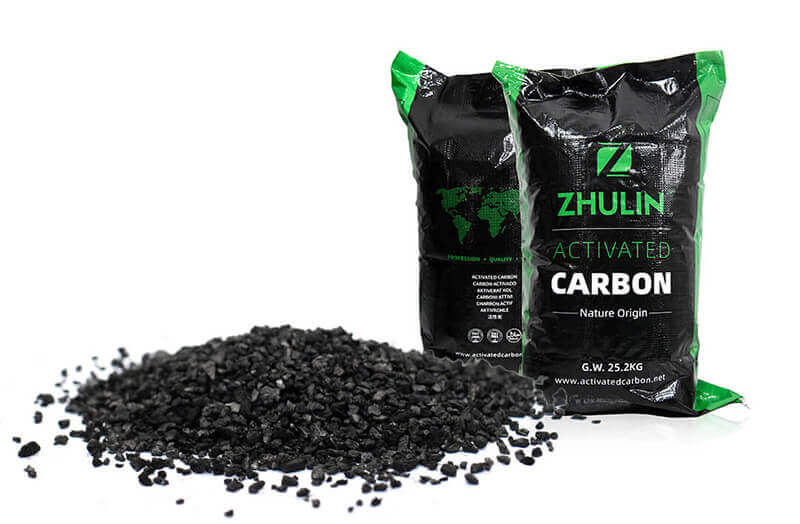
For DAF effluent polishing, the choice of carbon type, mesh size, and activity level directly impacts treatment performance, operating cost, and system longevity. Zhulin Carbon’s coal-based GAC at 12×40 mesh with an iodine value of 900 mg/g is specifically optimized for this application for several reasons:
- Optimized Pore Structure: bituminous coal produces a balanced pore size distribution with both micropores (for small organics like phenol) and mesopores (for larger oil molecules), giving broader adsorption spectrum than coconut carbon
- Ideal Mesh Size: 12×40 mesh (1.4–0.42 mm) provides the ideal balance between adsorption kinetics and hydraulic performance. It offers faster mass transfer than coarser 8×30 mesh while maintaining lower pressure drop than finer 20×50 mesh in fixed-bed columns
- Cost-Effective Activity: an iodine number of 900 mg/g indicates a well-developed micropore structure sufficient for adsorbing the dissolved organics typical of DAF effluent, at a more economical price point than higher-iodine grades
- Superior Hardness: coal-based GAC typically achieves 95–98% hardness, minimizing attrition and fines generation during backwashing and operation, extending bed life to 6–18 months
- Uniform Granules: uniform granular shape ensures even flow distribution and consistent contact time across the bed, preventing channeling and breakthrough
- Regenerable: suitable for thermal regeneration, allowing spent carbon to be reactivated and reused, reducing lifecycle costs and environmental footprint
Product Specifications: Coal-Based Granular Activated Carbon for DAF Effluent
The table below presents the full technical specifications of Zhulin Carbon’s coal-based GAC grade recommended for DAF effluent oily water polishing:
| Parameter | Specification | Unit | Notes |
| Raw Material | Bituminous coal | — | High-quality anthracite/bituminous blend |
| Manufacturing | Crushed → carbonized → steam-activated → screened | — | Physical activation, no chemical residue |
| Mesh Size (US) | 12 × 40 | mesh | 1.40 mm – 0.42 mm particle range |
| Effective Size (d10) | 0.50 – 0.70 | mm | Uniformity coefficient ≤ 1.9 |
| Uniformity Coefficient | ≤ 1.9 | — | Ensures even bed hydraulics |
| Iodine Number | ≥ 900 | mg/g | Micropore development indicator |
| Methylene Blue | ≥ 150 | mg/g | Mesopore adsorption capacity |
| CCL4 Adsorption | ≥ 45 | % | Total pore volume indicator |
| BET Surface Area | ≥ 850 – 1,000 | m²/g | N₂ adsorption method |
| Total Pore Volume | ≥ 0.45 | cm³/g | Micro + meso + macro pores |
| Apparent (Bulk) Density | 0.45 – 0.52 | g/cm³ | Backwashed, drained basis |
| Hardness | ≥ 95 | % | Ball-pan method; resists attrition |
| Ash Content | ≤ 12 | % | Mineral residue after burn-off |
| Moisture (as packed) | ≤ 5 | % | Weight loss at 150°C |
| pH | 6 – 9 | — | Near-neutral; water-washed available |
| Oil & Grease Removal | 90 – 99 | % | From DAF effluent typical 10–50 mg/L |
| COD Removal | 60 – 90 | % | Dependent on inlet COD & EBCT |
| Estimated Bed Life | 6 – 18 | months | Before changeout or regeneration |
System Design: GAC Polishing for DAF Effluent
Designing an effective GAC polishing system downstream of DAF requires attention to flow rate, contact time, bed configuration, and monitoring. Below is a practical design guide:
Step 1 — characterize the DAF effluent
Before sizing the carbon system, obtain a complete water analysis: flow rate (m³/h), oil & grease (mg/L), COD/TOC (mg/L), TSS (mg/L), pH, temperature, and any specific target compounds (BTEX, phenol). This determines the carbon loading requirement.
Step 2 — select the contact time (EBCT)
Empty Bed Contact Time (EBCT) of 10–25 minutes is recommended for DAF effluent. Higher EBCT (20–25 min) is used when targeting < 1 mg/L oil or < 30 mg/L COD; shorter EBCT (10–15 min) suffices for moderate polishing. For example, at 50 m³/h flow and 15 min EBCT, you need 12.5 m³ of carbon bed volume.
Step 3 — choose lead-lag or parallel configuration
A lead-lag (series) arrangement with two carbon vessels maximizes carbon utilization: the lead bed does the heavy lifting while the lag bed polishes to final target. When the lead bed saturates, it is replaced/regenerated, and the lag bed becomes the new lead. Parallel configuration is preferred for higher flow rates.
Step 4 — particle size selection
12×40 mesh is the optimal choice for most DAF effluent applications. It provides faster adsorption kinetics than 8×30 mesh (shorter mass transfer zone) and lower pressure drop than 20×50 mesh, reducing backwash frequency and energy consumption.
Step 5 — monitor breakthrough
Install online or daily grab-sample monitoring for oil & grease and COD at the GAC outlet. When effluent approaches 80% of the target limit, initiate carbon changeout. Typical indicators: oil > 5 mg/L, COD > 80% of inlet, or UV254 breakthrough.
Step 6 — spent carbon management
Zhulin Carbon offers spent carbon reactivation services. Saturated carbon is thermally regenerated at 850–950°C, restoring 80–90% of original capacity, significantly reducing lifecycle cost versus virgin carbon replacement.
Expected Treatment Performance
Typical Performance — Coal-Based GAC (12×40, Iodine 900) on DAF Effluent
Inlet Oil & Grease: 10 – 50 mg/L → Outlet: <1 – 5 mg/L (90 – 99% removal)
Inlet COD: 100 – 500 mg/L → Outlet: <30 – 100 mg/L (60 – 90% removal)
Inlet BTEX: 1 – 20 mg/L → Outlet: <0.05 – 0.5 mg/L (>95% removal)
Inlet Phenol: 5 – 50 mg/L → Outlet: <0.1 – 1 mg/L (>98% removal)
Inlet Surfactants: 5 – 30 mg/L → Outlet: <0.5 – 2 mg/L (85 – 95% removal)
(Actual performance depends on water matrix, temperature, EBCT, and carbon loading.)
Industrial Applications
DAF followed by GAC polishing with Zhulin Carbon’s coal-based granular carbon serves a wide range of industries:
- Oil Refineries: DAF removes bulk oil & suspended solids; GAC polishes dissolved organics, sulfides, and phenols before discharge or reuse
- Petrochemical Plants: treats process wastewater containing solvents, plasticizers, and aromatic compounds after DAF
- Oil & Gas Produced Water: polishes produced water after DAF/WEMCO treatment for reinjection or surface discharge
- Steel & Metal Working: removes rolling oils, drawing compounds, and cleaning solvents from DAF effluent
- Food & Beverage: treats plant washdown and process water; removes FOG residuals and dissolved organics post-DAF
- Chemical Manufacturing: polishes polymer-bearing wastewater and latex emulsions after DAF coagulation
- Textile & Dyeing: removes dyes, surfactants, and size chemicals from DAF-treated effluent
- Landfill Leachate: treats leachate after DAF for organics, color, and trace contaminants prior to discharge
Key Advantages of Coal-Based GAC for DAF Effluent
- Completes the Treatment Train: removes dissolved organics that DAF, coagulation, and filtration cannot address
- Proven Performance: 90–99% oil removal and 60–90% COD reduction ensure reliable compliance
- Economical: lower unit cost than coconut-shell carbon; regenerable for 2–3 cycles reducing lifecycle cost further
- Long Service Life: hard granules resist backwash attrition; 6–18 month bed life typical
- Optimal Hydraulics: 12×40 mesh balances adsorption kinetics with low pressure drop
- Full-Service Supply: virgin carbon supply, spent carbon reactivation, and technical support in one package
Why Choose Zhulin Carbon?
Zhulin Carbon is a leading manufacturer of activated carbon for industrial water treatment, with over two decades of experience serving refinery, petrochemical, and environmental engineering clients worldwide:
- Direct Manufacturer: in-house production from select bituminous coal; consistent iodine 900+ quality batch after batch
- Complete Product Range: coal, coconut, and wood-based carbons; impregnated and acid-washed grades; we match the carbon to your water
- Application Expertise: our lab performs isotherm testing and rapid mini-column (RMC) tests on your DAF effluent to predict carbon life and optimize EBCT
- Quality Assurance: ISO 9001 certified production; NSF/ANSI 61 available for drinking water applications; consistent quality documentation
- Reactivation Services: reactivation kilns restore 80–90% of spent carbon capacity, cutting replacement cost and waste
- Technical Support: from carbon selection to system startup, bed monitoring protocols, and changeout scheduling
- Global Logistics: flexible packaging: 25 kg bags, 500 kg super sacks, or bulk tanker delivery
Conclusion
Dissolved Air Flotation is an excellent first step for oily wastewater, but it cannot remove the dissolved organics, soluble oil fractions, and surfactants that remain in the effluent. Activated carbon adsorption is the proven polishing technology that bridges the gap between DAF and final discharge or reuse quality.
Zhulin Carbon’s coal-based granular activated carbon—at 12×40 mesh with an iodine value of 900 mg/g—offers the ideal combination of adsorption capacity, hydraulic performance, mechanical durability, and cost efficiency for DAF effluent treatment. With 90–99% oil removal and 60–90% COD reduction, it reliably delivers effluent quality that meets or exceeds regulatory limits.
Ready to Optimize Your DAF Effluent Treatment?
Send us your DAF effluent analysis (flow rate, oil & grease, COD, pH) and target outlet limits.
Our engineers will recommend the optimal carbon grade, bed volume, EBCT, and operating protocol.
Free samples and lab isotherm testing available.
Contact Zhulin Carbon today: info@activatedcarbon.net | www.activatedcarbon.net