
介紹
Hydrogen sulfide (H₂S) is one of the most troublesome contaminants in biogas, sewage gas, landfill gas, and various industrial gas streams. This colorless, flammable gas is instantly recognizable by its “rotten egg” odor at concentrations as low as 0.5 ppm — but its real damage goes far beyond the nose. In biogas cogeneration (CHP) engines, H₂S combustion produces sulfuric acid (H₂SO₄) vapor that corrodes engine cylinders, exhaust heat exchangers, and catalysts, shortening engine life from 60,000 hours to as little as 10,000 hours. Even trace H₂S in natural gas pipelines causes stress corrosion cracking in steel infrastructure.
At Zhulin Carbon, we manufacture KOH-impregnated coal-based columnar activated carbon specifically engineered for high-capacity H₂S removal. In this guide, we explain how impregnated carbon works, why KOH impregnation dramatically boosts performance, and — most importantly — we share a real customer case study from a biogas plant showing exactly how our carbon performs in the field.
How H₂S Harms Your Equipment
Whether your gas is biogas from an anaerobic digester, sewage gas from a wastewater treatment plant, or landfill gas from a municipal waste site, H₂S is almost always present — typically at 500–5,000 ppm, sometimes exceeding 10,000 ppm. The damage cascade is well documented:
- CHP gas engines (Jenbacher, Caterpillar, MWM) typically require H₂S <250 ppm (some <100 ppm). H₂S combustion forms H₂SO₄, corroding cylinder liners, valves, and turbochargers.
- Oxidation catalysts and SCR NOx catalysts are deactivated by sulfur. H₂S must typically be <10 ppm to protect catalyst systems.
- Natural gas pipeline specifications limit H₂S to <4 ppm (or even <0.25 ppm for some grids).
- H₂S is acutely toxic at 700 ppm (fatal within minutes); OSHA limits are 10 ppm (8-hour TWA) and 15 ppm (STEL).
- Membrane and PSA upgrading systems require H₂S <50 ppm to prevent membrane and adsorbent damage.
Activated carbon desulfurization is one of the simplest, most reliable, and most cost-effective methods for H₂S removal — especially for small-to-medium biogas plants (50–1,000 m³/h) where the capital cost of biological scrubbers or chemical washers is hard to justify.
How KOH-Impregnated Carbon Removes H₂S
Unmodified activated carbon adsorbs H₂S through weak physical forces, achieving only moderate capacity (typically 5–15 wt%). The breakthrough comes from chemical impregnation with potassium hydroxide (KOH), which transforms the carbon from a simple adsorbent into a powerful chemical scrubber.
When moist biogas passes through a bed of KOH-impregnated carbon, three reactions occur simultaneously on the carbon surface:
- KOH reacts directly with H₂S in an acid-base reaction: 2KOH + H₂S → K₂S + 2H₂O. The H₂S is permanently converted to solid potassium sulfide, locked within the carbon pore structure.
- The alkaline KOH surface catalyzes the oxidation of H₂S by trace oxygen in the gas stream: H₂S + ½O₂ → S⁰ + H₂O (at low humidity) or H₂S + 2O₂ → H₂SO₄ (at high humidity). The elemental sulfur or sulfuric acid is retained in the pores.
- The underlying carbon micropore structure provides additional adsorption capacity for H₂S and other organic sulfur compounds (mercaptans, siloxanes) that may be present in biogas.
The result: KOH-impregnated columnar carbon achieves H₂S adsorption capacities of 25–60 wt% — meaning 1 kg of carbon can remove 250–600 grams of H₂S. This is 5–10 times higher than unmodified carbon, dramatically reducing carbon consumption and replacement frequency.
Why Columnar (Cylindrical) Carbon with KOH Impregnation?
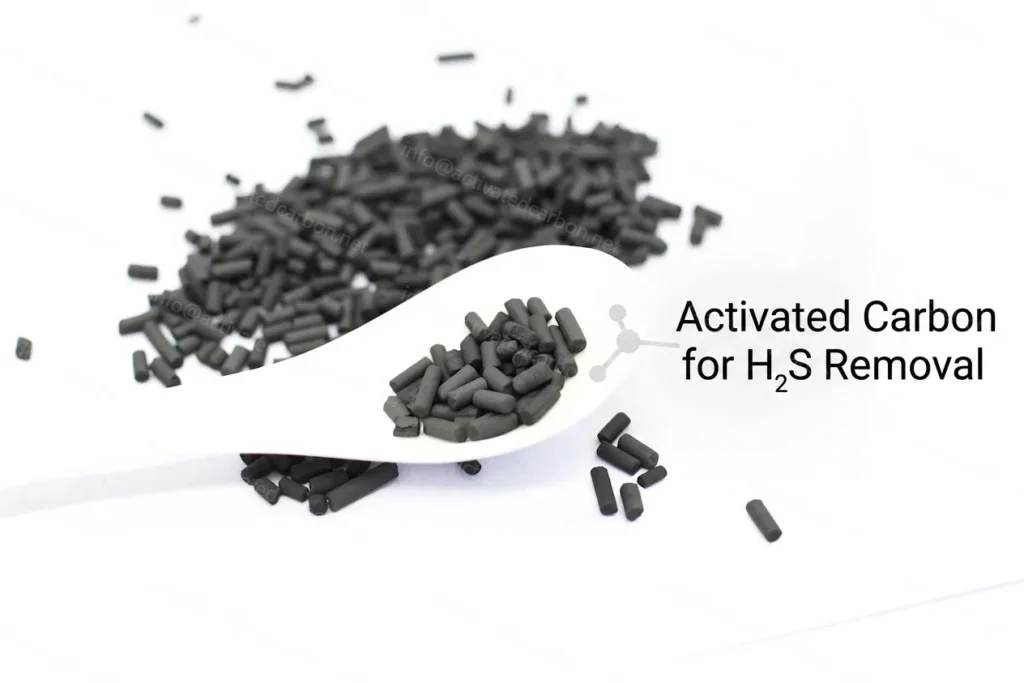
For H₂S removal from biogas and similar gas streams, the physical form of the carbon matters as much as its chemistry. Coal-based columnar activated carbon, impregnated with KOH, offers the ideal combination of properties:
- The uniform cylindrical pellets (typically 4 mm diameter) create regular gas flow channels in the filter bed, minimizing pressure drop. This is essential for biogas blowers that operate at low differential pressures (typically <50 mbar).
- Our impregnation process distributes KOH evenly throughout the pellet cross-section, not just on the outer surface. This ensures that the entire carbon mass participates in the H₂S reaction, maximizing utilization.
- A carbon tetrachloride adsorption value of 50% provides sufficient base pore development to support the impregnated chemistry while maintaining structural integrity after KOH loading.
- The coal-based columnar structure resists attrition from gas flow, vibration, and handling. Soft carbons would generate alkaline dust that contaminates downstream equipment.
- The KOH-impregnated carbon is designed to operate in water-saturated biogas (RH 80–100%). The moisture actually enhances the catalytic oxidation reaction — unlike desiccant-type carbons that lose capacity in humid gas.
- Coal-based columnar carbon is significantly cheaper than coconut-shell-based impregnated carbons, making it the preferred choice for high-volume, consumable desulfurization applications.
Technical Parameters of Our KOH-Impregnated Columnar Carbon
| 範圍 | 單元 | 規格 | Why It Matters for H₂S Removal |
| 原料 | — | Selected anthracite & bituminous coal | High carbon content, rigid structure |
| 製造流程 | — | Extrusion → Carbonization → Steam activation → KOH impregnation → Drying | Engineered surface chemistry for H₂S chemisorption |
| 顆粒直徑 | mm | 4.0 (also 3.0 / 1.5 available) | Standard 4 mm for biogas filters |
| 我懷孕了 | — | 氫氧化鉀 (KOH) | Transforms carbon into chemical scrubber |
| KOH Loading | wt% | 5 – 10 (typical 6–8) | Optimized for maximum H₂S capacity |
| CTC Adsorption | % (wt) | ≥ 50 | Base pore development; supports impregnated chemistry |
| Iodine Number (pre-impregnation) | 毫克/克 | ≥ 850 – 950 | Underlying pore quality indicator |
| Specific Surface Area (BET) | m²/g | ≥ 800 – 1,000 | Adequate pore volume for reaction products |
| Apparent / Bulk Density | g/cm³ | 0.50 – 0.60 | Higher density due to KOH loading |
| Hardness / Abrasion Number | % | ≥ 95 | Resists dusting under gas flow |
| 灰分含量 | % | ≤ 15 (includes KOH) | KOH counted as ash; normal for impregnated carbon |
| Moisture (as packed) | % | ≤ 10 | Some residual moisture is acceptable |
| pH (surface) | — | Strongly alkaline (>10) | Critical for acid-base H₂S neutralization |
| Pellet Length | mm | 5 – 20 (typical) | Uniform geometry for even gas distribution |
| H₂S Adsorption Capacity | wt% | 25 – 60 (typical, lab-determined) | 5–10× higher than unmodified carbon; depends on humidity & O₂ |
| H₂S Removal Efficiency | % | > 98 (typical) | Reduces H₂S from thousands of ppm to target |
| Operating Temperature | °C | 5 – 50 | Typical biogas digester temperature range |
| Operating Humidity | % RH | 60 – 100 (optimal 80–100%) | Moisture enhances catalytic oxidation |
Customer Case Study: Biogas Plant H₂S Treatment in Practice
To illustrate how these specifications translate into real-world performance, here is a project we completed for a biogas plant operator.
Case Study: Biogas Digester H₂S Desulfurization
應用: Anaerobic digester biogas desulfurization (for CHP engine protection)
Biogas Flow Rate: 80 m³/h
Inlet H₂S Concentration: 1,700 ppm
Treatment Target: Outlet H₂S ≤ 25–50 ppm
System Configuration:
- Two parallel activated carbon filters (lead-lag switchable)
- Each filter holds 750 kg of carbon
- Carbon grade: 4 mm KOH-impregnated columnar carbon, CTC ≥50%
Design Performance & Carbon Consumption:
| Outlet Target | Expected Carbon Usage | Monthly Consumption | Filter Cycles |
|---|---|---|---|
| ≤ 25 ppm H₂S | ~46 kg/day | ≈ 1,380 kg/month | ≈ 1.84 tanks/month |
| ≤ 50 ppm H₂S | ~45 kg/day | ≈ 1,345 kg/month | ≈ 1.79 tanks/month |
Analysis & Key Takeaways:
- At 1,700 ppm inlet and 80 m³/h flow, the system must remove ~136 g H₂S/h (3.3 kg H₂S/day).
- Our 4mm KOH-impregnated carbon achieves an effective H₂S working capacity of ~7–8 wt% under these operating conditions, consuming ~45–46 kg/day.
- The two 750 kg filters in parallel provide a combined 1,500 kg carbon inventory, giving approximately 32–33 days of continuous operation per full charge.
- The operator switches the lead/lag position monthly, replacing the saturated filter while the second filter continues treatment — ensuring zero downtime.
- The marginal difference between 25 ppm and 50 ppm targets (only ~35 kg/month) demonstrates the carbon’s steep adsorption isotherm: most H₂S is removed in the early stage of the bed, and tightening the outlet target adds minimal cost.
How to Design an H₂S Removal System with Impregnated Carbon
Based on our experience across hundreds of biogas, sewage gas, and landfill gas projects, here is a practical design approach:
1. Measure H₂S and gas composition: Test the raw gas for H₂S concentration (ppm), flow rate (m³/h), temperature, humidity, O₂ content, and CO₂ content. H₂S levels can vary daily, so take multiple samples over a week. Also check for siloxanes (common in sewage gas) and VOCs that may compete for adsorption sites.
2. Calculate the H₂S load: H₂S load (kg/day) = Flow rate (m³/h) × H₂S (ppm) × 24h × 34/22.4 × 10⁻⁶. This determines the carbon consumption rate and expected filter service life.
3. Select the target outlet concentration: For CHP engines: typically 25–50 ppm. For biomethane upgrading (membrane/PSA): 10–50 ppm. For pipeline injection: <4 ppm. Tighter targets increase carbon consumption but protect downstream equipment.
4. Size the carbon filter: Determine EBCT (Empty Bed Contact Time). For KOH-impregnated carbon: minimum 15–25 seconds for biogas at moderate H₂S (<2,000 ppm); 25–40 seconds for high H₂S (>2,000 ppm). Use two filters in parallel or lead-lag for continuous operation.
5. Ensure proper operating conditions: Gas temperature: 5–50°C (ambient is ideal). Humidity: 80–100% RH is optimal for the catalytic oxidation reaction. If the gas is too dry, inject steam or water mist upstream. Remove liquid water droplets with a demister before the carbon bed to prevent flooding.
6. Monitor and replace: Install H₂S sensors at inlet and outlet. When the outlet concentration exceeds the target, replace the carbon in the lead filter. Spent KOH-impregnated carbon containing sulfur/sulfide should be disposed of according to local regulations — it is typically non-hazardous but may have a high pH.
Where Is This Technology Applied?
- Biogas plants (agricultural, food waste, animal manure) — CHP engine protection
- Wastewater treatment plants — sewage gas / digester gas desulfurization
- Landfill gas collection — LFG-to-energy projects
- Industrial biogas — palm oil mill effluent (POME), brewery, distillery waste
- Natural gas processing — sweetening low-volume sour gas streams
- Petrochemical and refinery — tail gas and vent gas H₂S polishing
- Geothermal power — non-condensable gas H₂S removal
- Pulp and paper — digester gas and recovery boiler emissions
Why Choose Zhulin Carbon for H₂S Removal?
Zhulin Carbon has supplied KOH-impregnated columnar carbon to biogas plants, wastewater treatment facilities, and landfill gas projects worldwide. Here is what sets us apart:
- Our KOH loading is precisely controlled at 6–8 wt% to maximize H₂S capacity without pellet softening or dusting.
- Our 4 mm CTC50 KOH carbon delivers 25–60 wt% H₂S working capacity under typical biogas conditions — verified in field projects like the case study above.
- Uniform 4 mm diameter with ≥95% hardness ensures low pressure drop and minimal fines, even after months of operation.
- We can adjust KOH loading and pellet diameter to match your specific gas composition and filter design. Other impregnants (NaOH, KI, CuO) also available for specialized applications.
- Our engineers help you calculate carbon consumption, size filters, optimize EBCT, and design lead-lag switching protocols.
- Available in 25 kg bags, 500 kg / 1,000 kg super sacks, or bulk delivery. We maintain stock for rapid resupply to minimize filter downtime.
- Every batch tested for CTC, pellet diameter, hardness, bulk density, and KOH loading per GB/ASTM standards.
結論
H₂S removal is a critical treatment step for any biogas, sewage gas, or landfill gas utilization project. KOH-impregnated coal-based columnar activated carbon offers the optimal combination of high H₂S capacity (25–60 wt%), low pressure drop, reliable performance in humid gas, and cost-effectiveness for small-to-medium gas flows. As demonstrated in our biogas plant case study — treating 80 m³/h of biogas with 1,700 ppm H₂S down to 25–50 ppm — our 4 mm KOH-impregnated carbon delivers predictable performance at a consumption rate of approximately 1,345–1,380 kg/month, protecting CHP engines and ensuring compliant gas quality.
Planning a biogas or industrial gas desulfurization project? Contact our technical team at info@zhulincarbon.com or call +86-19949132731 for free samples, H₂S capacity testing, and expert system sizing support.