
Введение
Palladium (Pd) is one of the most valuable precious metals on Earth — with prices consistently exceeding $2,000 per troy ounce. It is indispensable in automotive catalytic converters, electronics manufacturing, pharmaceutical synthesis, and chemical catalysis. As global demand soars and natural deposits deplete, recovering palladium from secondary sources — spent catalysts, electronic waste (e-waste), plating rinses, and refinery leach solutions — has become both an economic necessity and an environmental imperative.
Among all recovery technologies, adsorption onto modified activated carbon stands out for its simplicity, selectivity, and cost-efficiency. At Zhulin Carbon, we produce coconut shell activated carbon impregnated with nitric acid (HNO₃) specifically engineered for high-capacity palladium adsorption from aqueous solutions. In this guide, we explain how it works, why nitric acid modification is critical, and what specifications you should look for.
Why Is Palladium Recovery Important?
Palladium belongs to the platinum group metals (PGMs), a family of six precious elements that are rare, difficult to mine, and strategically critical. The drivers for palladium recovery include:
- Automotive catalytic converters consume ~80% of global Pd supply; electronics, dentistry, and chemical catalysts account for most of the remainder.
- Over 75% of primary Pd comes from just two countries (Russia and South Africa). Geopolitical risks make supply unreliable.
- Printed circuit boards, mobile phones, and connectors contain 100–1,000 g/ton of Pd — far richer than the 5–10 g/ton found in mined ore.
- Urban mining of Pd from waste reduces the environmental footprint of mining, prevents toxic metal leaching into ecosystems, and supports circular economy goals.
- Even dilute solutions (10–500 ppm Pd) represent significant value; efficient recovery directly impacts the bottom line.
Industrial palladium-bearing solutions typically arise from: spent Pd/Al₂O₃ catalyst leaching (aqua regia or HCl/Cl₂), electronics recycling acid leaching, electroplating rinse waters, and refinery raffinates. These solutions are often complex, containing competing base metals (Cu, Ni, Fe, Zn) alongside the target palladium.
How Activated Carbon Adsorbs Palladium
In acidic chloride solutions — the most common medium for Pd processing — palladium exists predominantly as the tetrachloropalladate(II) anion, [PdCl₄]²⁻. The adsorption of this anion onto activated carbon involves multiple mechanisms:
- Oxygen-containing surface functional groups (particularly carboxyl –COOH and phenolic –OH) act as ion-exchange sites, releasing H⁺ and capturing [PdCl₄]²⁻ from solution.
- Surface oxygen groups form coordinate bonds with Pd²⁺ ions, creating stable surface complexes that lock the metal onto the carbon.
- The carbon surface can act as a mild reducing agent, converting Pd²⁺ to Pd⁰ (metallic palladium nanoparticles) on the carbon surface. This is enhanced by the electron-donating capacity of the carbon lattice.
- The micropore network (<2 nm) of coconut shell carbon traps [PdCl₄]²⁻ ions and Pd-organic complexes through van der Waals forces and size exclusion.
- The graphitic basal planes of activated carbon interact with the d-orbitals of palladium species through electron donor-acceptor mechanisms.
Unmodified coconut shell carbon adsorbs Pd at moderate capacity. But when the carbon surface is oxidized with nitric acid, the density of carboxyl, lactone, and phenolic groups increases dramatically — boosting Pd adsorption capacity by 2–5 times.
Why Nitric Acid (HNO₃) Impregnation Is Appropriate
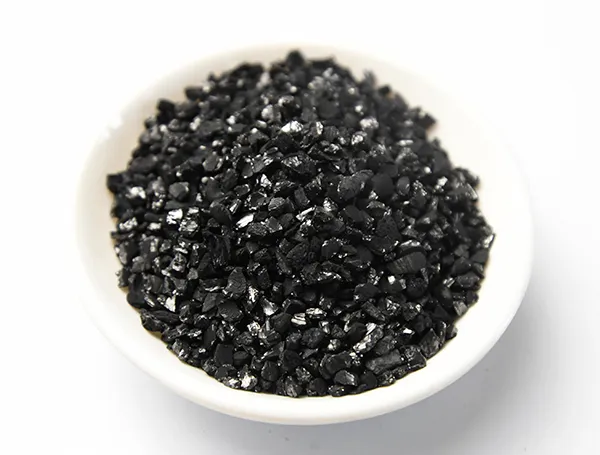
The key to high-performance palladium adsorption lies in the surface chemistry of the carbon. Untreated coconut shell carbon has a relatively hydrophobic, low-oxygen surface. Treatment with nitric acid achieves several critical modifications simultaneously:
- HNO₃ oxidizes the carbon surface, generating large numbers of –COOH groups. These are the primary binding sites for [PdCl₄]²⁻ through ion exchange: R–COOH + [PdCl₄]²⁻ → R–COO–PdCl₃ + HCl + Cl⁻.
- Additional oxygen functional groups contribute to Pd complexation and improve wettability, allowing aqueous Pd solutions to penetrate the pore network more effectively.
- The total acidic group density on HNO₃-treated carbon can reach 1.5–3.0 mmol/g, compared to 0.3–0.6 mmol/g on untreated carbon — a 3–5x improvement in ion-exchange capacity.
- Mild HNO₃ treatment removes amorphous carbon deposits and tar residues from pore entrances, improving access to the micropore interior without destroying the pore structure.
- The oxygen-rich surface shows preferential affinity for soft Lewis acids like Pd²⁺ (a soft acid) over hard Lewis acids like Fe³⁺, Cu²⁺, and Ni²⁺, enhancing selectivity in complex solutions.
The result: HNO₃-impregnated coconut shell carbon can achieve Pd adsorption capacities of 80–200 mg Pd/g carbon — far exceeding the 20–50 mg/g typical of unmodified carbon.
Why Coconut Shell Carbon Is the Ideal Substrate
Among all activated carbon raw materials, coconut shell is the best substrate for precious metal adsorption for several reasons:
- Coconut shell carbon has >85% micropores (<2 nm), providing the highest surface area per gram (1,000–1,500 m²/g). This maximizes the density of adsorption sites for Pd ions and complexes.
- The rigid structure of coconut shell carbon withstands acid treatment, repeated loading/elution cycles, and mechanical handling without degradation — critical for industrial recovery operations.
- Minimal mineral content means fewer competing adsorption sites and less interference from soluble ash components in acidic Pd solutions.
- Coconut shells are an agricultural byproduct; their use supports sustainability and reduces carbon footprint compared to coal-based carbons.
- Steam activation of coconut shells produces a narrow, uniform micropore distribution ideal for trapping small Pd species (kinetic diameter of [PdCl₄]²⁻ ~5 Å).
Technical Parameters of Our HNO₃-Impregnated Coconut Shell Carbon for Pd Adsorption
| Параметр | Единица | Спецификация | Why It Matters for Pd Adsorption |
| Сырье | — | Premium coconut shell | High hardness, renewable, low ash |
| Производственный процесс | — | Steam activation → HNO₃ impregnation → Washing → Drying | Engineered surface chemistry for Pd capture |
| Размер частиц | сетка | 5×10 | Select by column flow rate & bed design |
| Йодное число | мг/г | ≥ 1,000 – 1,200 | High micropore surface area |
| Specific Surface Area (BET) | m²/g | ≥ 1,100 – 1,500 | Maximum adsorption sites for Pd species |
| Total Pore Volume | cm³/g | ≥ 0.50 | Adequate space for diffusion |
| Micropore Volume (<2 nm) | cm³/g | ≥ 0.40 | Micropore-dominated; ideal for Pd ion trapping |
| Apparent / Bulk Density | g/cm³ | 0.45 – 0.52 | Optimized mass-per-volume |
| Hardness / Abrasion Number | % | ≥ 97 | Survives acid treatment & repeated elution cycles |
| Содержание золы | % | ≤ 5 | Minimal mineral interference in acidic Pd solutions |
| Moisture (as packed) | % | ≤ 5 | Maximum active carbon content |
| Surface Oxygen Groups (Boehm) | mmol/g | ≥ 1.5 – 3.0 | High density of –COOH, lactone, phenolic groups for Pd binding |
| Carboxyl Group Density | mmol/g | ≥ 0.8 – 1.5 | Primary ion-exchange sites for [PdCl₄]²⁻ capture |
| pH (aqueous extract) | — | 3.0 – 5.0 (acidic surface) | Acidic surface enhances Pd²⁺ selectivity over base metals |
| CTC Adsorption | % (wt) | ≥ 55 – 60 | Confirms well-developed pore structure |
| Pd Adsorption Capacity | mg Pd/g | 80 – 200 (typical, lab-determined) | 2–5× higher than unmodified carbon |
| Pd Selectivity (Pd vs Cu/Ni/Fe) | — | High (Kd > 10⁴ for Pd) | Preferential Pd uptake from mixed-metal solutions |
How to Recover Palladium Using Modified Activated Carbon
A typical Pd recovery process using HNO₃-impregnated coconut shell carbon involves four main stages: adsorption, elution, regeneration, and metal refining.
1. Solution preparation: Adjust the Pd-bearing leach solution to the optimal pH (typically pH 1–3 in HCl medium) and chloride concentration (0.5–2 M Cl⁻). Pre-filter to remove suspended solids. If competing metals are present at very high concentrations, consider a selective precipitation or solvent extraction pre-treatment.
2. Adsorption (column or batch): Column mode: Pass the solution through a fixed bed of HNO₃-impregnated carbon at a flow rate giving 10–30 minutes EBCT. Monitor Pd breakthrough at the outlet. Batch mode: Add carbon at 1–10 g/L dosage, stir for 2–6 hours, then filter. Typical Pd removal: >95% in single pass.
3. Elution (stripping): Strip adsorbed Pd from the loaded carbon using a strong eluant: (a) acidic thiourea solution (1–5% thiourea in 0.1–1 M HCl), or (b) ammoniacal solution (5–10% NH₃). Thiourea achieves >98% Pd recovery in a single elution. The concentrated eluate is sent for Pd precipitation or electrowinning.
4. Carbon regeneration: After 3–5 adsorption-elution cycles, regenerate the carbon thermally (700–800 °C under steam/N₂) or re-impregnate with HNO₃ to restore surface oxygen groups. Coconut shell carbon’s high hardness allows 5–10 regeneration cycles before replacement.
5. Pd refining: Precipitate Pd from the eluate as (NH₄)₂PdCl₆ using NH₄Cl, or reduce directly to Pd sponge with hydrazine or formic acid. The final Pd product purity: ≥99.9%.
Where Is This Technology Applied?
- Spent automotive catalyst recycling — leaching Pd from ceramic honeycomb substrates
- Electronics and e-waste recycling — recovering Pd from PCB leach solutions and connector scrap
- Chemical and pharmaceutical catalyst recovery — Pd/C catalyst regeneration streams
- Electroplating industry — Pd recovery from plating bath rinses and drag-out tanks
- Petroleum refining — Pd-containing catalyst treatment and leachate processing
- Precious metal refineries — polishing Pd from tailings and barren solutions
- Analytical laboratories — Pd pre-concentration for trace analysis
- Jewelry manufacturing — Pd recovery from polishing sludges and waste solutions
Why Choose Zhulin Carbon for Palladium Recovery?
Zhulin Carbon understands that precious metal recovery demands carbon of the highest purity, consistency, and engineered surface chemistry. Here is what sets us apart:
- Our proprietary acid-treatment process creates a precisely engineered surface oxygen group profile, maximizing carboxyl density (≥0.8–1.5 mmol/g) for maximum Pd binding capacity.
- We select only high-quality coconut shells from tropical plantations, ensuring consistently high hardness (≥97%) and low ash (≤5%).
- Lab-tested Pd adsorption capacity of 80–200 mg/g, verified under realistic industrial conditions (pH 1–3, HCl/Cl⁻ medium).
- Strict QC protocol: every batch tested for iodine number, BET surface area, hardness, ash, and Boehm titration of surface oxygen groups.
- Our metallurgy team can run lab-scale adsorption isotherms and column tests on your specific Pd solution to optimize dosage and process parameters.
- We offer re-impregnation services to restore surface chemistry after multiple elution cycles, extending carbon lifespan and reducing costs.
- 5×10, 6×12, or custom; 1 kg / 5 kg / 25 kg bags or super sacks. Secure packaging for international shipping.
Заключение
Palladium recovery is one of the highest-value applications of activated carbon technology. HNO₃-impregnated coconut shell activated carbon — with its engineered surface oxygen chemistry, superior micropore structure, exceptional hardness, and high Pd selectivity — delivers adsorption capacities of 80–200 mg Pd/g, making it the most cost-effective solution for recovering this strategic precious metal from spent catalysts, e-waste, plating solutions, and refinery streams. With Zhulin Carbon’s specialized grades and metallurgical expertise, recyclers and refiners can maximize Pd recovery while minimizing operating costs.
Ready to boost your palladium recovery efficiency? Contact our technical team at info@activatedcarbon.net or call +86-19949132731 for free samples, lab-scale adsorption testing on your solution, and expert process design support.